10.2.1 |
optiPoint 410 and optiPoint 410 S Telephones |
10.2.1.1 |
optiPoint 410 entry, optiPoint 410 entry S |
Main features |
| • | Protocols |
| - | H.323, HFA/V3 + V4, CorNet IP, SIP |
| - | HTTP, DHCP, SNMP, FTP |
| - | H.235 (security) |
| - | QoS to DIFFSERV and IEEE 802.1 p/Q |
| • | Voice compression G.711, G.722, G.723 and G.729 A/B |
| • | Power over LAN (in accordance with Cisco and standard pre802.3af) |
| • | CTI (for example, via TAPI 3rd party) |
| • | 1 Ethernet (10/100BaseT) interface (self-configuring) for LAN connection |
| • | 8 function keys with LEDs |
| • | 2 volume adjustment keys (plus/minus) and pitch |
| • | Suitable for wall mounting |
| • | No modularity (no connection option for adapters or key modules), no display |
Standard key assignment (default) for optiPoint 410 entry, optiPoint 410 entry S |
| Refer to Section 10.2.3 "Connection and Startup" for information on connection and startup. |
10.2.1.2 |
optiPoint 410 economy, optiPoint 410 economy S |
Main features |
| • | Protocols |
| - | H.323, HFA/V3 + V4, CorNet IP, SIP |
| - | HTTP, DHCP, SNMP, FTP |
| - | H.235 (security) |
| - | QoS to DIFFSERV and IEEE 802.1 p/Q |
| • | Voice compression G.711, G.722, G.723 and G.729 A/B |
| • | Power over LAN (in accordance with Cisco and standard pre802.3af) |
| • | CTI (for example, via TAPI 3rd party) |
| • | 1 Ethernet (10/100BaseT) interface (self-configuring) for LAN connection |
| • | 12 function keys with LEDs |
| • | Alphanumeric LCD display (swivel) with 2 lines, 24 characters each |
| • | 3 dialog keys for interactive user prompts: "Yes", "Back", and "Next" |
| • | Open listening |
| • | 2 volume adjustment keys (plus/minus), pitch and display contrast |
| • | Suitable for wall mounting |
| • | No modularity (no connecting capability for adapters or add-on devices) |
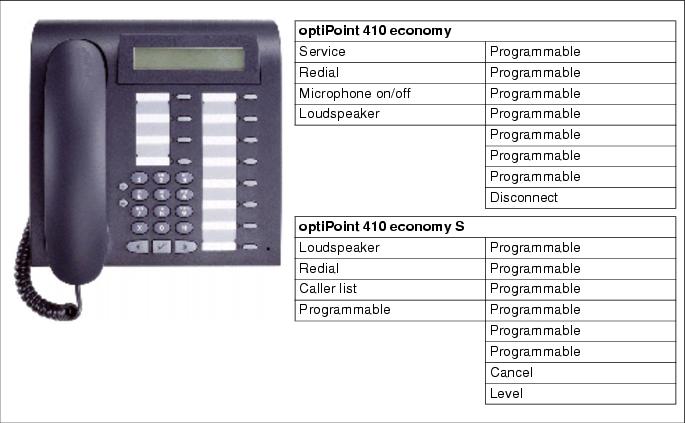
Standard key assignment (default) for optiPoint 410 economy, optiPoint 410 economy S |
| Refer to Section 10.2.3 "Connection and Startup" for information on connection and startup. |
10.2.1.3 |
optiPoint 410 economy plus, optiPoint 410 economy plus S |
Main features |
| • | Protocols |
| - | H.323, HFA/V3 + V4, CorNet IP, SIP |
| - | HTTP, DHCP, SNMP, FTP |
| - | H.235 (security) |
| - | QoS to DIFFSERV and IEEE 802.1 p/Q |
| • | Voice compression G.711, G.722, G.723 and G.729 A/B |
| • | Power over LAN (in accordance with Cisco and standard pre802.3af) |
| • | CTI (for example, via TAPI 1st Party) |
| • | 1 Ethernet (10/100BaseT) interface (self-configuring) for LAN connection |
| • | 1 Ethernet (10/100BaseT) interface (self-configuring) for the PC connection |
| • | 12 function keys with LEDs |
| • | Alphanumeric LCD display (swivel) with 2 lines, 24 characters each |
| • | 3 dialog keys for interactive user prompts: "Yes", "Back", and "Next" |
| • | Open listening |
| • | Port for headset (121 TR 9-5) |
| • | 2 volume adjustment keys (plus/minus), pitch and display contrast |
| • | Suitable for wall mounting |
| • | No modularity (no connection option for adapters or key modules) |
Standard key assignment (default) for optiPoint 410 economy plus, optiPoint 410 economy plus S |
| Refer to Section 10.2.3 "Connection and Startup" for information on connection and startup. |
10.2.1.4 |
optiPoint 410 standard, optiPoint 410 standard S |
Main features |
| • | Protocols |
| - | H.323, HFA/V3 + V4, CorNet IP, SIP |
| - | HTTP, DHCP, SNMP, FTP |
| - | H.235 (security) |
| - | QoS to DIFFSERV and IEEE 802.1 p/Q |
| • | Voice compression G.711, G.722, G.723 and G.729 A/B |
| • | Power over LAN (in accordance with Cisco and standard pre802.3af) |
| • | CTI (for example, via TAPI 1st Party) |
| • | 1 Ethernet (10/100BaseT) interface (self-configuring) for LAN connection |
| • | 1 Ethernet (10/100BaseT) interface (self-configuring) for the PC connection |
| • | 12 function keys with LEDs |
| • | Alphanumeric LCD display (swivel) with 2 lines, 24 characters each |
| • | 3 dialog keys for interactive user prompts: "Yes", "Back", and "Next" |
| • | Full-duplex speakerphone mode with echo suppression for room adaptation |
| • | Port for headset (121 TR 9-5) |
| • | 2 volume adjustment keys (plus/minus), pitch, speaker quality and display contrast |
| • | Modularity: |
| - | 2 option bays |
| - | 1 interface for up to 2 add-on devices |
| • | Suitable for wall mounting |
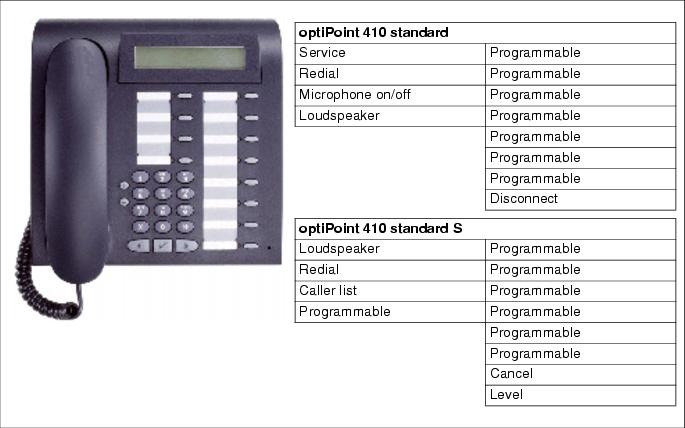
Standard key assignment (default) for optiPoint 410 standard, optiPoint 410 standard S |
| Refer to Section 10.2.3 "Connection and Startup" for information on connection and startup. |
10.2.1.5 |
optiPoint 410 advance, optiPoint 410 advance S |
Main features |
| • | Protocols |
| - | H.323, HFA/V3 + V4, CorNet IP, SIP |
| - | HTTP, DHCP, SNMP, FTP |
| - | H.235 (security) |
| - | QoS to DIFFSERV and IEEE 802.1 p/Q |
| • | Voice compression G.711, G.722, G.723 and G.729 A/B |
| • | Power over LAN (in accordance with Cisco and standard pre802.3af) |
| • | CTI (for example, via TAPI 1st Party) |
| • | 1 Ethernet (10/100BaseT) interface (self-configuring) for LAN connection |
| • | 1 Ethernet (10/100BaseT) interface (self-configuring) for the PC connection |
| • | 1 integrated USB 1.1 interface |
| • | 19 function keys with LEDs |
| • | Graphic display (swivel) with 4 lines, 24 characters each |
| • | 3 dialog keys for interactive user prompts: "Yes", "Back", and "Next" |
| • | Full-duplex speakerphone mode with echo suppression for room adaptation |
| • | Port for headset (121 TR 9-5) |
| • | 2 volume adjustment keys (plus/minus), pitch, speaker quality and display contrast |
| • | Modularity: |
| - | 1 option bay |
| - | 1 interface for up to 2 add-on devices |
| • | Suitable for wall mounting |
Standard key assignment (default) for optiPoint 410 advance, optiPoint 410 advance S |
| Refer to Section 10.2.3 "Connection and Startup" for information on connection and startup. |
| HiPath 3000/5000 V9, Service Documentation, Issue 10 | up  |
|
 |
||
| Disclaimer & Copyright | ID: P31003H3590S100017620 | 2014-02-27 |