|

|
3.2.16 |
UPSC-D |
Introduction |
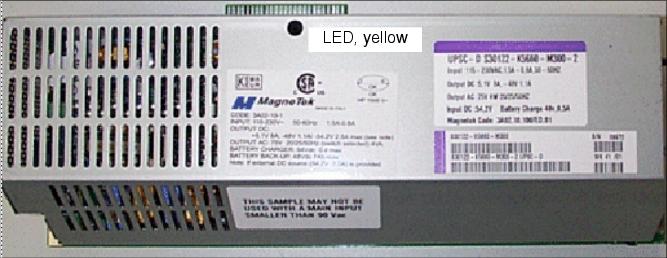
| The UPSC-D board (S30122-K5660-A300, S30122-K5660-M300 (Figure 3-22)) is used in HiPath 3550 and HiPath 3350 (wall housing). The UPSC-D board supports power supply and battery management functions. No other components are required if operated as an AC power supply. To be able to switch over to emergency battery operation if there is a failure of the AC supply, there must be an additional battery pack connected. |
Power supply unit |
| The UPSC-D board is only released for permanent operation in an AC grid. Permanent operation is not permitted in a DC network. |
| The temporary connection to a DC supply (48 V battery pack or 48 V-DC power) serves to bridge a failure of the AC supply. The battery pack should be given preference. |
External power supply |
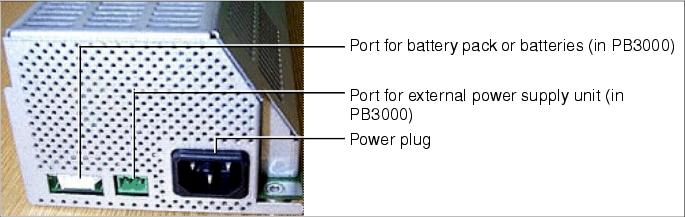
| If the power supplied by the UPSC-D is insufficient, an external power supply (i.e., a Powerbox PB3000 with LUNA2) can be installed to provide additional power. To do this, connect the DC output on the PB3000 to the special -48-Vdc input on the UPSC-D. The UPSC-D's internal -48-V output is deactivated when the external power supply is connected. |
Emergency battery operation |
| In order to be able to switch over to emergency battery operation if there is a failure of the line voltage or external power supply, one of the following measures can be taken: |
| • | An additional 48 V/1.2 Ah battery pack should be connected to the UPSC-D. |
| • | A 48 V/7 Ah battery pack should be installed in the Powerbox PB3000. If the PB3000 is to be used only for emergency battery operation, but not as an external power supply, a LUNA2 is not required. |
Approved battery packs for UPSC-D |
| The following battery packs have been approved and released for operation with the UPSC-D board: |
| • | 48 V battery pack S30122-K5928-X (4 x 12 V/1.2 Ah) |
| • | 48 V battery pack 4 x V39113-W5123-E891 (4 x 12 V/7 Ah) |
| • | Not approved: The 24 V-battery pack S30122-K5403-X is not approved. |
|
|
Technical Specifications |
| • | Nominal voltage range: 100 VAC - 240 VAC |
| • | Nominal frequency: 50 Hz - 60 Hz |
| • | Ring voltage generator 75 Vac, 20/25/50 Hz |
| • | Partial voltages: +5 VDC, -48 V |
| • | Battery charger: 4 x 12 V (40,8 V-55,2 V) |
| • | Power consumption: 180 W |
| • | Bridging times: See next paragraph. |
Bridging times |
| The maximum possible bridging times of the HiPath 3350 and HiPath 3550 systems in emergency battery mode can be found here, i.e., if the power supply has failed. A distinction is made between a 48 V/1.2 Ah battery pack and the Power Box with 48 V/7 Ah (without LUNA2). The bridging times are determined under the following conditions: |
| • | All measurements were performed at a room temperature of approximately 23 °C (73.4 °F). |
| • | The batteries were fully charged when the measurement was started. |
| The maximum bridging times given in the tables are basic orientation values. They can vary from the values given here depending on your system configuration. |
|
|
|
|
|
|
|
|
|
|
|
|
|
|
|
|
|
|
|
|
|
|
|
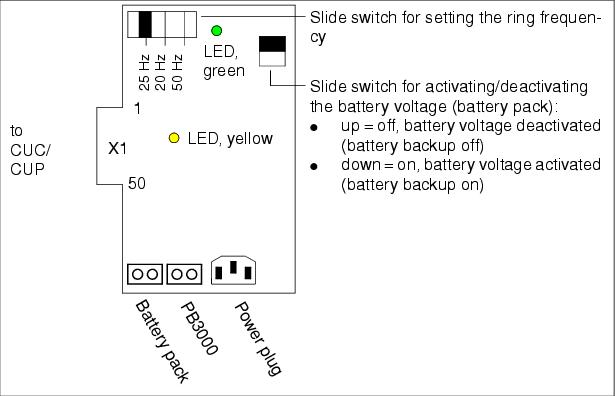
Diagram of UPSC-D |
Switches and indicators |
|
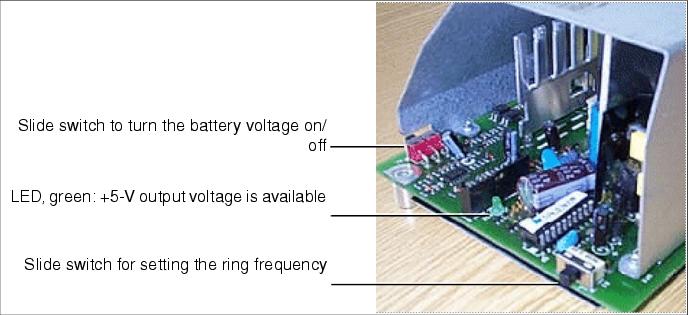
| • | LED, green: +5-V output voltage is available. |
| • | LED, yellow: -48-V output voltage is supplied by the external power supply (Powerbox PB3000 with LUNA2). |
| • | Slide switch for setting the ring frequency: - 25 Hz (GER + international market) - 20 Hz (U.S.) - 50 Hz (France) |
| • | Slide switch for activating and deactivating the battery voltage (battery pack): |
| - | up = off, battery voltage deactivated (battery backup off) |
| - | down = on, battery voltage activated (battery backup on) |
Connectors |
| HiPath 3000/5000 V9, Service Documentation, Issue 10 | up  |
|
|
||
| Disclaimer & Copyright | ID: P31003H3590S100017620 | 2014-02-27 |